Singing Classes for Kids in Singapore
13 October 2026 · Tutor Circle
Singing classes for kids in Singapore are either a choir, where the child learns to hold a part with other children, or a one-to-one vocal lesson, where a teacher fixes pitch, breath and songs. School choir is the class most children should try first. A private lesson is the class to add when one child needs more than the rehearsal can give.
- Start
- Group singing from about 4 or 5. One-to-one often from lower primary
- School choir
- The usual first choir. It trains blending, not a solo grade
- ABRSM
- Singing, and Singing for Musical Theatre, from Grade 1 to Grade 8
- Grades 6 to 8
- Need Grade 5 theory, Practical Musicianship, or a listed alternative first
- Voice change
- Many boys’ range drops in lower secondary. Keep singing in a comfortable key
- Home tutor
- Tutor Circle matches a vocal tutor. Parents pay the tutor
Choir, a studio class, or a private teacher
A child who sings in tune with the radio may still freeze in a room of parents. The class has to match the reason you are booking it.
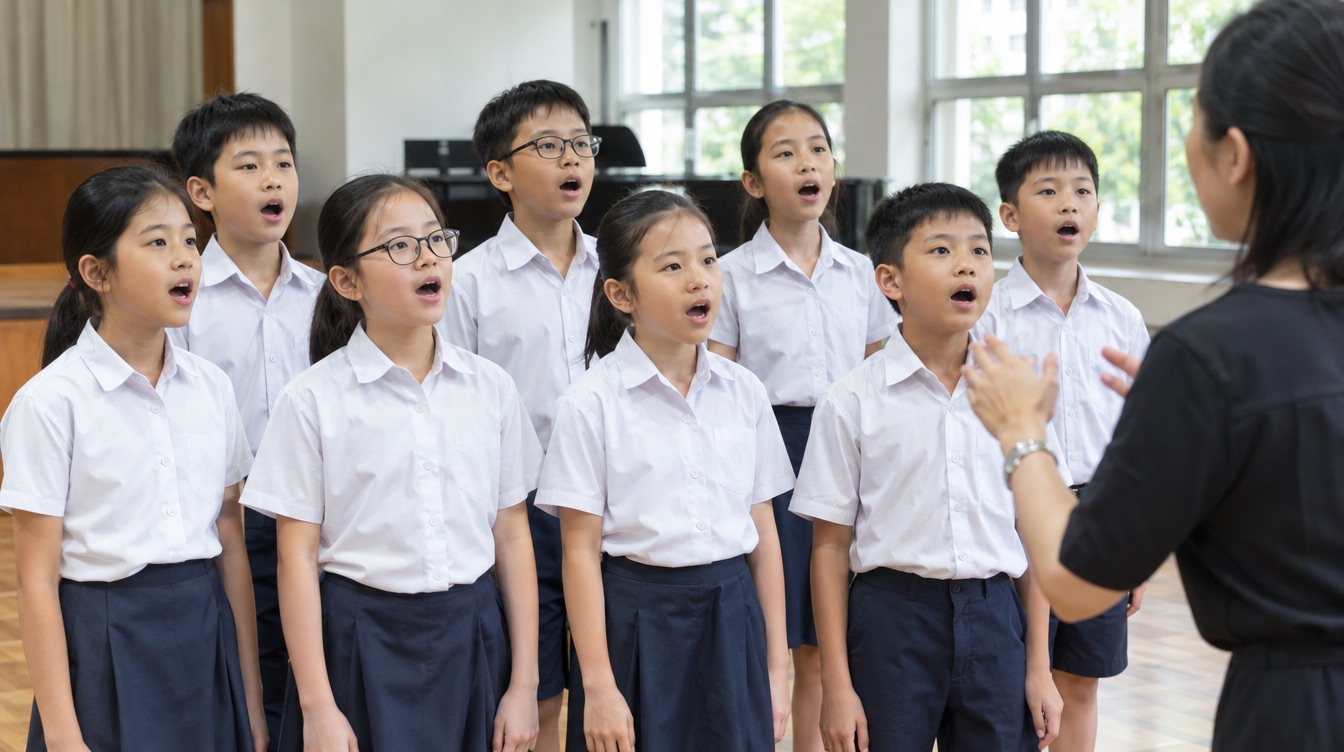
- School choir or a children’s choir: the child learns entries, dynamics and standing in a group. Fees at school are the CCA arrangement. An external choir may charge a term fee and sell a concert costume.
- Small group vocal class: more attention than a choir of forty, less than a private lesson. Useful for musical-theatre camps.
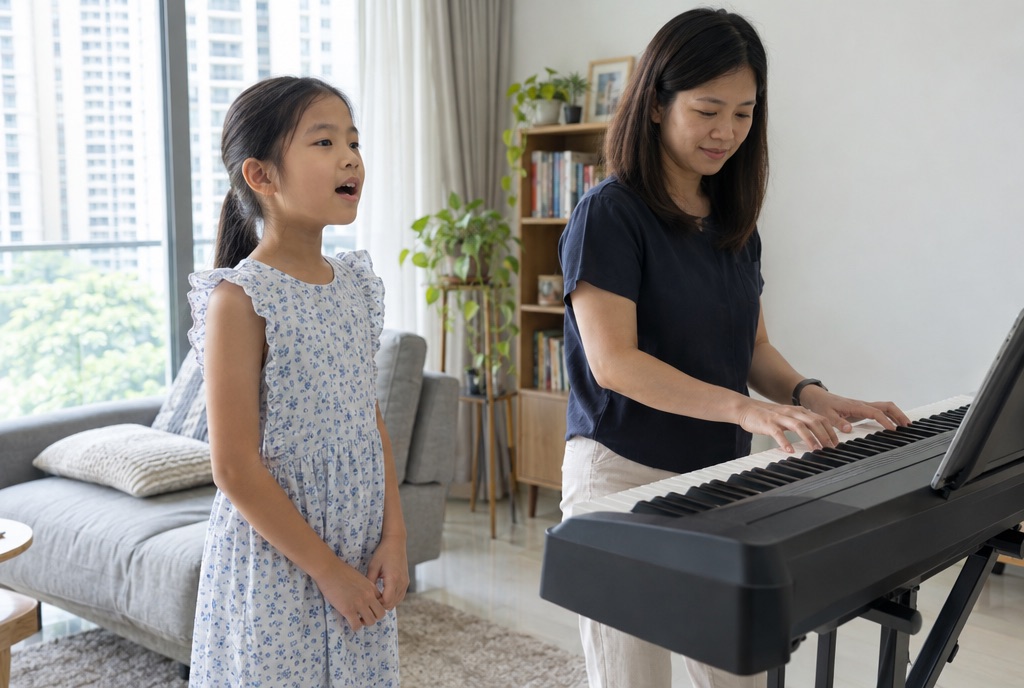
- One-to-one lesson at home or online: the teacher hears that child only. This is the format for a grade, a solo, or a pitch problem the choir cannot stop to fix.
- A school such as SOTA, or a junior department such as NAFA: a later path if performing is going to be a large part of the week. SOTA theatre and music places are by audition through the Talent Academy, not by joining a neighbourhood choir.
The wider map of schools and home tutors is on the music school page. [3] [4]
Which singing class fits
| Class | The child learns | Choose it when | Limit |
|---|---|---|---|
| School choir | Blend, rhythm, performing with friends | They like music and can attend rehearsal | Little time for one solo problem |
| External children’s choir | A higher rehearsal standard and concerts | School choir is too light and the child wants more | Travel, and a term commitment |
| Musical-theatre group | Song, character, simple dance | They want a show, not a grade book | The singing technique can stay shallow |
| One-to-one vocal lesson | Pitch, breath, one song done properly | A solo, a grade, or a habit the choir cannot fix | No ensemble unless you add a choir |
ABRSM singing and musical theatre
ABRSM singing practical grades, and Singing for Musical Theatre, run from Grade 1 to Grade 8. [1] A practical singing exam is a performance of set songs plus the technical and aural work the syllabus requires. Musical theatre is a different list of songs and a different performance style. Pick the list the child wants to sing.
From Grade 6, the same theory gate applies as for piano and guitar. The candidate needs Grade 5 or above in Music Theory, Practical Musicianship, or a listed alternative, before booking. [1] Trinity is the other board vocal teachers enter. [2]
A grade is optional
Many children sing well in a choir and never enter an exam. Book a grade when the songs are ready and the child wants the certificate. Entering Grade 1 to decorate a school portfolio, before the child can hold a phrase, teaches them to dislike the exam.
How children should practise
Daily singing practice targets teachers commonly set
Warm up, then the four bars that broke last lesson, then the song once. Volume is not the goal. A neighbour should not be able to tell it is practice from the corridor.
Voice change, and keeping the voice healthy
Many boys find, in lower secondary, that notes which were easy in Primary 6 crack or disappear. That is a range change, not a failure. The teacher should move the song down. A choir with more than one part can give him the lower line until the voice settles. Stopping for a year, or pushing the old high notes, both leave him less able to sing when the voice stabilises.
- Water, and a night’s sleep, do more for a child’s voice than any spray.
- Hoarseness that lasts more than a fortnight is a reason to rest the voice and ask a doctor, before the next rehearsal.
- Shouting at recess and then singing for an hour is how choirs lose voices before a concert. The teacher can say this. A parent has to enforce the recess part.
How to choose a singing teacher
- The child should sing in the trial, not only watch the teacher demonstrate.
- Ask what the first month covers: matching pitch, one song, and a way to practise at home.
- Ask whether the teacher will work with the school choir’s songs, or only with a grade book.
- For musical theatre, ask to hear a student who is the same age, not a conservatory recording.
- Online lessons work when the child already matches pitch. A first assessment is clearer in the room.
Piano and guitar are the instruments that support a singer who later wants grades. Those guides are here: piano lessons and guitar lessons.
To request a vocal tutor, send the age and the goal. Coordinators are available daily from 9am to 8pm.
Questions parents ask
What age can a child start singing classes in Singapore?
Children can sing in a short group from about 4 or 5. One-to-one lessons usually wait until the child can repeat a short phrase and stand for 30 minutes, often from lower primary. ABRSM practical singing grades start at Grade 1, not at an Initial Grade. There is no rule that a child must pass a grade before joining a school choir.
Is school choir enough?
School choir is the right place to learn blending, standing still, and singing with other children. It is weak at fixing one child’s pitch or breath, because the rehearsal is for the group. Add a one-to-one lesson if the child wants solo songs, a grade, or a musical-theatre audition and the choir teacher has already said the group rehearsal cannot cover that.
What exams can a child take in singing?
ABRSM offers singing practical grades from Grade 1 to Grade 8, and a separate Singing for Musical Theatre syllabus from Grade 1 to Grade 8. Grades 6, 7 and 8 require a pass at Grade 5 or above in Music Theory, Practical Musicianship, or a listed alternative, before booking. Trinity is the other board teachers in Singapore enter. Grades are optional.
What should parents do when a boy’s voice changes?
During lower secondary, many boys’ speaking and singing range drops and becomes unreliable for a few months. Keep him singing, in a comfortable range, and tell the teacher. Forcing the old high part, or stopping completely for a year, both make the return harder. A choir that has a lower part can keep him in the group while the voice settles.
How long should a child practise singing?
Ten to fifteen minutes a day is plenty at the start: warm-up, one hard phrase, then the song. The chart on this page is a teaching target, not an ABRSM rule. Shouting the song in the bathroom is not practice. A quiet corner and a starting note from a keyboard or a phone app are enough.
Can Tutor Circle find a singing tutor?
Yes. Request a vocal tutor for home or online lessons. Say the child’s age, whether you want choir support, grades, or musical theatre, and the days you can do. WhatsApp +65 9628 4702, daily 9am to 8pm. Parents pay the tutor. There is no parent agency fee.
Sources
Grade ranges are from ABRSM. Choir arrangements and practice minutes are teaching practice. SOTA and NAFA are cited for families who later want a school or a junior department, not as Saturday choirs.
- ABRSM, “Practical Grades.” Singing and Singing for Musical Theatre are offered from Grade 1 to Grade 8. Initial Grade is listed for piano and bowed strings. Practical Grades 6, 7 and 8 require Grade 5 or above in Music Theory, Practical Musicianship, or a listed Jazz Practical Grade. Accessed 13 October 2026. https://www.abrsm.org/en-gb/practical-grades/about-practical-grades
- Trinity College London, music qualifications. Trinity graded singing exams are the other certificate route used by vocal teachers in Singapore. Use the current syllabus for the grade you enter. Accessed 13 October 2026. https://www.trinitycollege.com/qualifications/music
- School of the Arts, Singapore, Talent Academy. Theatre and music are audition areas for applicants. Year 1 admission is through DSA, not through the Secondary 1 posting exercise. A Saturday singing class is not an application to SOTA. Accessed 13 October 2026. https://www.sota.edu.sg/talent-academy/
- Nanyang Academy of Fine Arts, School of Young Talents. Junior courses include music and drama, and music students are prepared for performance and international examinations. Accessed 13 October 2026. https://www.nafa.edu.sg/schools/school-of-young-talents