Music Schools in Singapore
13 October 2026 · Tutor Circle
A music school in Singapore is a place that employs teachers and runs lessons on a term calendar. It can be a neighbourhood studio, a junior department such as NAFA’s School of Young Talents, or, for a full school place, the School of the Arts. A private tutor at home is the other common route. The right one depends on the instrument, the child’s age, and whether you want a certificate.
- Three routes
- A neighbourhood music school, a home or online tutor, or a specialised school place at SOTA
- Junior campus courses
- NAFA School of Young Talents teaches music, art, dance and drama. Piano preparatory starts at age 5
- SOTA
- Specialised independent school. Year 1 entry is by DSA audition, not by PSLE posting
- Exam boards
- ABRSM and Trinity. Grades are optional. ABRSM Grades 6 to 8 need Grade 5 theory or a listed alternative
- School CCA
- Band, choir and Chinese orchestra are the free ensemble path inside a mainstream school
- Home tutor
- Tutor Circle matches instrumental tutors. Parents pay the tutor
The three ways families learn music
People search for a music school when they want a teacher, a room and a plan. Those three things do not have to come from the same building.
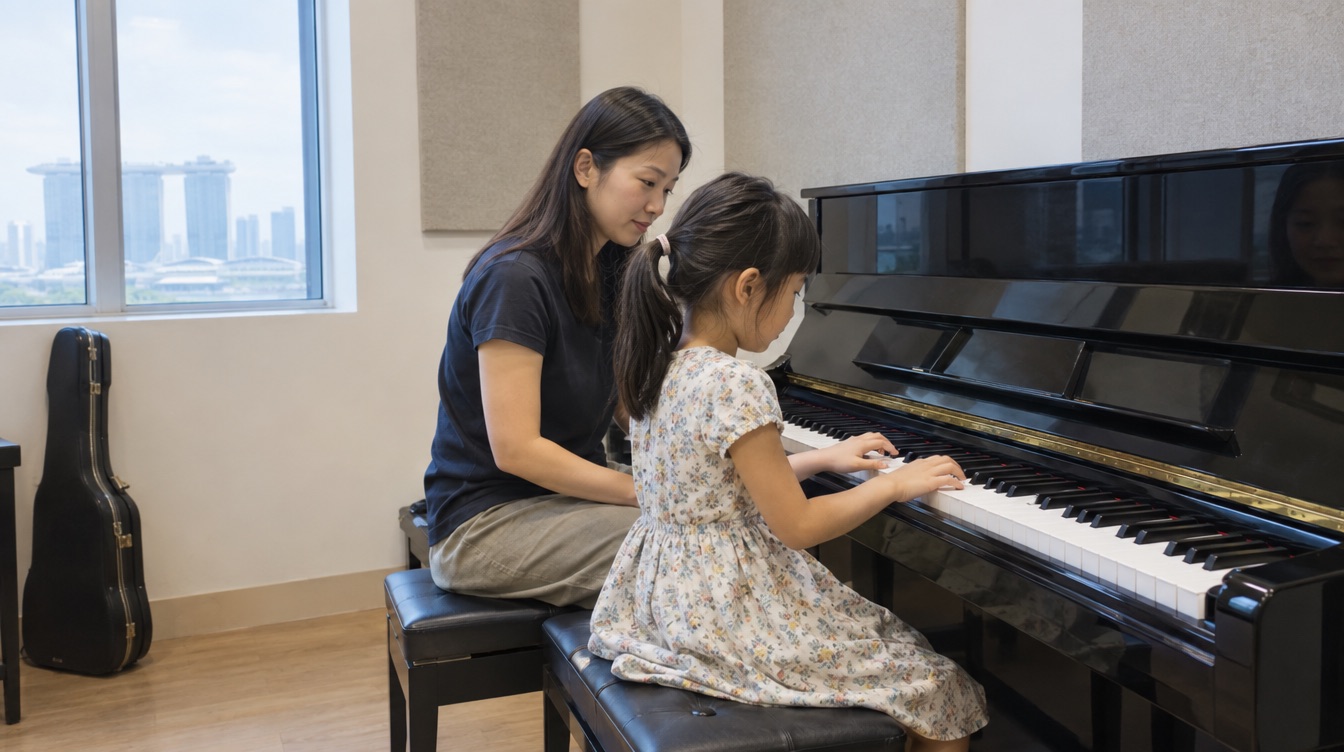
- A music school or junior department runs terms, employs teachers, and often adds theory, aural and a concert. NAFA’s School of Young Talents is the clearest public example: music students are trained for international exams and for performance, beside courses in art, dance and drama. Piano preparatory is for children aged 5. Junior Art runs from 5 to 17.
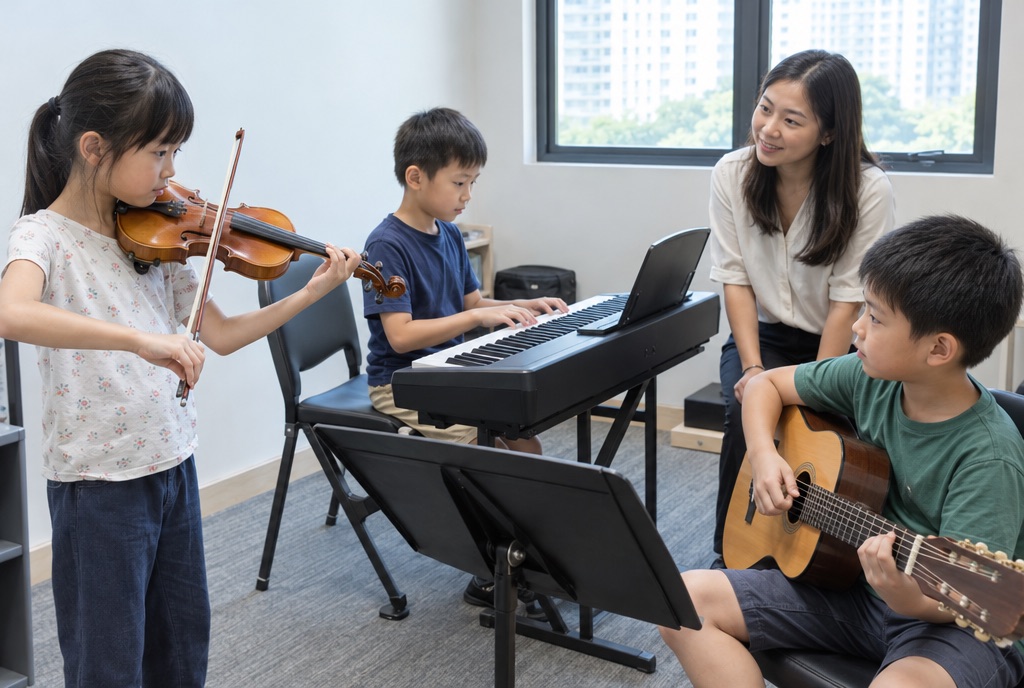
- A home or online tutor teaches one student on the instrument in the house. The calendar is the family’s, which matters in a week already full of CCA.
- School of the Arts, Singapore is a specialised independent school at 1 Zubir Said Drive. Music is one talent area, beside dance, theatre, literary arts, visual arts and film. Year 1 students come through the Talent Academy and DSA. SOTA does not join the Secondary 1 posting exercise.
Mainstream schools add a fourth, quieter route: band, choir and Chinese orchestra as CCA. That is ensemble training, and it is part of the school day. It does not replace a weekly instrumental lesson if the child is preparing a grade.
What each route is for
| Route | Best for | You get | You still arrange |
|---|---|---|---|
| Neighbourhood music school | A fixed weekly slot and a studio piano | A room, a term, often a concert | Practice at home, and exam entry fees |
| NAFA School of Young Talents | A campus junior programme and a graded path | Structured levels, performance requirements on the music courses | Travel to the campus, and the entry requirements for that instrument |
| Home or online tutor | One child, a tight week, or an instrument you already own | A teacher matched to the goal | The instrument, a quiet corner, and the weekly practice |
| SOTA, via DSA | A teenager who wants the art form to be the school | Academic lessons plus talent training, after audition | A portfolio or audition, and PSLE eligibility for the MOE DSA route |
| School band, choir, Chinese orchestra | Ensemble, friends, and a reason to keep playing | Rehearsals inside school | A separate teacher if solo exams are the goal |
Sources for the NAFA and SOTA rows: NAFA School of Young Talents and piano programme; SOTA Talent Academy; MOE SchoolFinder. [1] [2] [3] [4]
ABRSM, Trinity and the theory requirement
ABRSM Practical Grades run from Initial Grade to Grade 8 for piano and bowed strings, and from Grade 1 to Grade 8 for a wide range of other instruments and for singing. In a practical exam the candidate plays set pieces and, for the practical grade, does technical work, sight-reading and aural tests. The piano detail is on the piano page. Guitar is on the guitar page.
Students do not have to sit every grade in sequence. From Grade 6 upward, ABRSM requires a pass at Grade 5 or above in Music Theory, Practical Musicianship, or a listed Jazz Practical Grade, before the practical exam is booked. [5] Trinity is the other board used in Singapore. Pick one board for the grade the student is in.
A grade is not a school admission
A Grade 5 certificate shows that the student prepared a syllabus. SOTA’s music audition looks at the applicant in the room. Read the year’s Talent Academy notes before you assume a grade number is the audition. [3]
What a useful music week contains
The lesson is the shortest part of the week. The bars below are a planning split for a primary-age instrumental student who is also doing a little theory. They are a teaching plan, not a rule from any exam board.
A sample week, in minutes, for a primary instrumental student
Ages and instruments
| Age | What usually works | Where to look |
|---|---|---|
| 4 to 5 | Group musicianship, singing, keeping a beat. Individual piano if the child can sit | A short group class, or NAFA preparatory piano at 5 |
| 6 to 9 | One instrument, 30 to 45 minutes, optional Grade 1 when ready | Home tutor or a junior school |
| 10 to 12 | Grade progress or ensemble. Portfolio time if SOTA or DSA is a real plan | One teacher plus school band or choir |
| 13 and above | Grades 5 to 8, a band, or SOTA if they already hold a place | Specialist teacher. Theory caught up before Grade 6 |
| Adults | One instrument, songs or a grade, 45 to 60 minutes | Home or online tutor |
Singing has its own class types, from choir to one-to-one vocal lessons. That choice is set out in the singing guide.
How to choose a music school or a tutor
- Watch a trial. The teacher should listen, correct one thing, and set practice the child can finish.
- Ask who teaches if the named teacher is away. A school with a substitute policy is clearer than a school that goes silent.
- Ask whether theory is in the fee. At ABRSM it becomes compulsory in practice once the student wants Grade 6.
- Read the notice period before you pay a term deposit.
- For SOTA, use the official Talent Academy dates for that year. A music school recital is not an application.
If you want the teacher to come to you, request a match and name the instrument. Parents pay the tutor for lessons conducted. There is no parent agency fee.
Questions parents ask
What is a music school in Singapore?
A music school is a studio or campus that employs teachers, sets a term calendar, and usually offers more than one instrument. Some are neighbourhood branches. Some, such as NAFA’s School of Young Talents, are part of an arts institution. A private tutor who comes to your home is a different arrangement: one teacher, your piano or guitar, no term to join.
Is the School of the Arts a music school?
School of the Arts, Singapore (SOTA) is a specialised independent school. Students take academic subjects and train in one art form, including music. Year 1 admission is through Direct School Admission, with an audition at the Talent Academy. SOTA does not take part in the normal Secondary 1 posting exercise. It is a school place, not a Saturday class.
Do children need ABRSM exams to learn music?
No. ABRSM and Trinity grades are optional certificates. They are useful for a clear ladder and for some portfolios. Practical Grades 6, 7 and 8 at ABRSM require Grade 5 or above in theory, Practical Musicianship, or a listed alternative, before booking. A child learning for enjoyment can skip grades entirely.
What age do structured music courses start?
NAFA’s preparatory piano is for children aged 5, and its Junior Art courses also start at 5. Many neighbourhood music schools take children from about 4 in a group musicianship class, then move them to an instrument. A younger child can sing and keep a beat at home or in a short group. An individual exam syllabus can wait.
Can a child learn at a music school and with a home tutor?
Some do, and it only works if both teachers know. Two piano methods in the same week confuse fingering. A common split that does work is a school ensemble or theory class, plus one instrumental teacher. Tell each teacher what the other is covering.
How do I find an instrumental tutor if I do not want a term at a school?
Request a tutor through Tutor Circle for piano, guitar, singing or another instrument. Lessons can be at home or online. Parents pay the tutor. WhatsApp +65 9628 4702, daily 9am to 8pm, or use the request form.
Sources
- Nanyang Academy of Fine Arts, School of Young Talents. Courses cover art, dance, drama and music, with music and dance students prepared for international examinations and performance. Junior Art runs from ages 5 to 17. Accessed 13 October 2026. https://www.nafa.edu.sg/schools/school-of-young-talents
- Nanyang Academy of Fine Arts, “Piano Programme.” Preparatory piano is for children aged 5. The route continues through graded levels, with external ABRSM or Trinity exams described for Grade 8 and diploma students. Accessed 13 October 2026. https://www.nafa.edu.sg/courses/courses-for-children/piano-program
- School of the Arts, Singapore, Talent Academy. Applicants audition in dance, literary arts, music, theatre and visual arts, among other forms. Year 1 (Secondary 1) applicants are Primary 6 pupils. SOTA states that it admits its Year 1 cohort through DSA and does not participate in the Secondary 1 posting exercise. Accessed 13 October 2026. https://www.sota.edu.sg/talent-academy/
- Ministry of Education, SchoolFinder, School of the Arts, Singapore. MOE lists SOTA as a specialised independent school and states that it does not participate in the S1 posting process. Interested students apply through DSA-Sec. Accessed 13 October 2026. https://www.moe.gov.sg/schoolfinder/schooldetail/school-of-the-arts-singapore
- ABRSM, “Practical Grades.” Initial Grade to Grade 8 for piano and bowed strings. Grade 1 to Grade 8 for a wide range of instruments and for singing. Grades 6 to 8 require Grade 5 or above in Music Theory, Practical Musicianship, or a listed alternative. Accessed 13 October 2026. https://www.abrsm.org/en-gb/practical-grades/about-practical-grades