Piano Lessons in Singapore
13 October 2026 · Tutor Circle
Piano lessons in Singapore are a weekly class with one teacher, at home, online, or at a music school. Families book them for a first instrument, for ABRSM or Trinity grades, or for an adult who wants to play again. The useful choice is the lesson the student will still attend in six months.
- Usual start
- Many children begin at 5 to 7. NAFA’s preparatory piano course is for age 5
- Lesson length
- Commonly 30, 45 or 60 minutes, once a week
- Exam boards
- ABRSM and Trinity. Grades are optional
- ABRSM piano practical
- Initial Grade to Grade 8: three pieces, scales, sight-reading and aural
- Grades 6 to 8
- Book only after Grade 5 theory, Practical Musicianship, or a listed alternative
- Home lessons
- Tutor Circle matches a piano tutor. Parents pay the tutor. No parent agency fee
What to decide before the first piano lesson
Three answers shape the teacher you need. Name the student, the goal, and the instrument that is actually in the home.
- Age and attention. A five-year-old needs songs, games and a short lesson. A teenager can work on a full grade or on songs they chose.
- Exam or playing. ABRSM and Trinity give a certificate and a repertoire list. A student who wants pop, worship music or jazz needs a teacher who will teach that, and who will still fix the hand shape.
- The piano. Weighted keys matter. A tabletop keyboard with light keys teaches a touch the student has to unlearn on a real piano.
A trial lesson should show whether the teacher can explain one small thing, hear the student, and leave a practice task that fits the week. A long speech about the teacher’s own diploma is a weaker signal than ten minutes of teaching.
A home tutor, a music school, or both
Singapore families use both. A music school gives a room, a piano, a term calendar and sometimes a concert. A home tutor comes to the flat, or teaches on a video call, and can move the day when CCA changes. The music school guide compares those paths, including NAFA’s School of Young Talents and the School of the Arts.
| Arrangement | Where it happens | Fits best when | Ask before you pay |
|---|---|---|---|
| One-to-one at home | Your flat, on your piano | CCA nights, a young child, or a parent who wants to hear the lesson | Lesson length, travel, and what happens if you postpone |
| One-to-one online | Zoom or a similar call | The student can follow a screen and already has a piano at home | Camera angle on the hands, and who hosts a full hour |
| Music school studio | A branch or a campus | You want a fixed room, recitals, and a term plan | Whether theory is included, and the notice period |
| Group musicianship | A school or community class | A young child is not ready to sit alone at the piano | Class size, and when individual piano starts |
Exam entry is a separate fee, paid to the board, on top of lessons. Ask the teacher which session they enter in Singapore, and whether the student is ready. Entering every year on a birthday is a calendar. Entering when the pieces are secure is a result.
What an ABRSM piano exam tests
ABRSM Practical Grades for piano run from Initial Grade to Grade 8. In the face-to-face exam the candidate plays three pieces, scales and arpeggios, a sight-reading test and aural tests. [2] Performance Grades are a different exam, marked from a video, with a stronger focus on the performance itself.
Students do not have to pass each grade before the next one. The exception is the top of the ladder. Before anyone books Practical Grade 6, 7 or 8, they need a pass at Grade 5 or above in Music Theory, Practical Musicianship, or a listed Jazz Practical Grade. [1] Build theory in alongside the pieces from about Grade 3, so Grade 5 theory is not a panic year.
Trinity College London is the other board piano teachers in Singapore use. [4] The certificates are different. A student mid-grade should stay with one board unless there is a clear reason to switch. NAFA’s young musicians’ piano route uses internal exams through the earlier grades, and points external ABRSM or Trinity exams at Grade 8 and diploma level. [3]
How much practice actually helps
The lesson is one hour a week. The other six days are the course. Teachers in Singapore commonly set the daily targets below. They are a planning guide. They are not an ABRSM requirement.
Daily practice targets teachers commonly set
Split the time: scales first, then the hardest four bars, then a run-through. Practising only the piece the student already likes leaves the weak bars untouched.
Piano lessons by age and goal
| Student | A useful first goal | Lesson that usually fits |
|---|---|---|
| Age 5 to 7, new to the piano | Sit, count, and play a short tune with a rounded hand | 30 minutes with a teacher who has taught this age |
| Primary school, exam track | One grade when the pieces are ready | 45 minutes, plus short daily practice |
| Teenager | The next grade, or songs they actually want to play | 45 to 60 minutes |
| Adult beginner or returner | One piece, with a hand position that does not hurt | 45 to 60 minutes, at home or online |
If the goal is a school or an arts course
A graded certificate can support a portfolio. It does not by itself admit a child to the School of the Arts. SOTA takes its Year 1 cohort through Direct School Admission, with an audition, and it does not join the normal Secondary 1 posting exercise. Read the music school page before you plan the teenage years around one grade number.
Guitar and singing use the same weekly habit, on a different instrument. The guitar guide and the singing guide set those out.
Piano lessons in an HDB flat
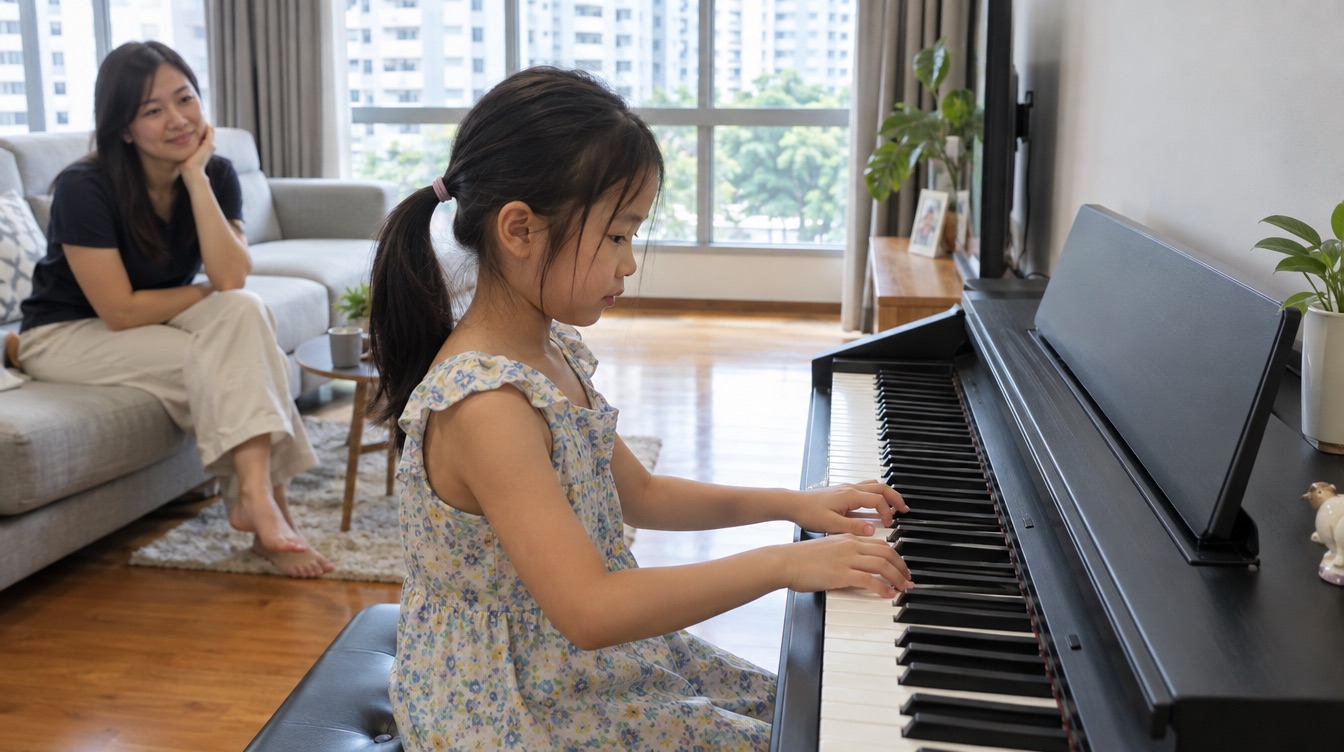
- Put the piano against a wall the student can sit at without blocking a doorway. A full-size digital piano on a stand is enough for grades.
- Use headphones for late practice. An acoustic piano carries. Agree a practice hour the household can keep.
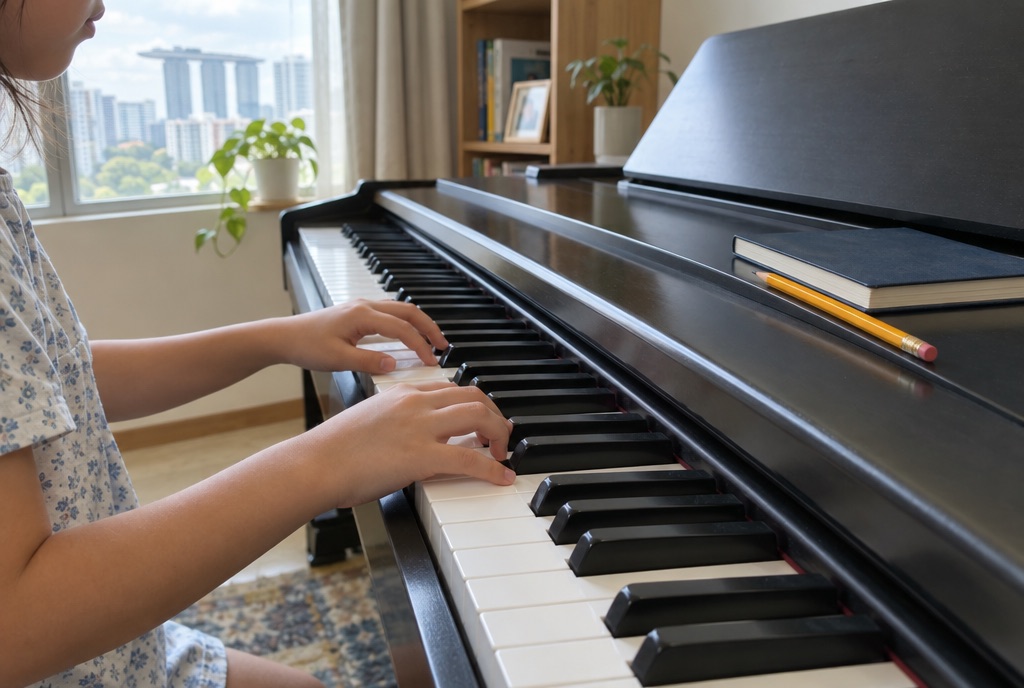
- Keep the ABRSM or Trinity book, a pencil, and a notebook on the stand. The teacher writes the week’s bars in the notebook, not in a chat that gets lost.
- For an online lesson, angle the camera so the teacher can see both hands. A phone flat on the rack is a weak view.
How to request a piano tutor
Tutor Circle matches one-to-one piano tutors for lessons at home or online. Say the age, the goal, the instrument you own, and the days you can do. Coordinators reply daily from 9am to 8pm, usually with profiles within 24 hours. Parents pay the tutor for lessons that take place.
Questions parents ask
How much do piano lessons cost in Singapore?
There is no national fee. A music school publishes a term fee for a set lesson length, often 30, 45 or 60 minutes, and the fee changes with the teacher’s qualification and the branch. A home tutor quotes a rate for the lesson at your flat, and travel can sit inside that quote. Ask what the fee includes: the lesson only, or theory, books and an exam entry as well. Agree the rate before the first lesson.
What age should a child start piano lessons in Singapore?
Many children start between 5 and 7, when they can sit for half an hour and use a few fingers independently. NAFA’s preparatory piano course is for children aged 5 who are musically inclined. A younger child can still enjoy music through singing and movement. Forcing a 4-year-old through a grade book usually ends the lessons.
Do piano students have to take ABRSM exams?
No. ABRSM and Trinity grades are a map, not a requirement. They help when a student wants a certificate, a school portfolio, or a clear next step. A student who wants to play hymns, pop songs or jazz can learn without entering an exam. If they do take ABRSM Practical Grades, Grades 6, 7 and 8 require a pass at Grade 5 or above in Music Theory, Practical Musicianship, or a listed alternative, before the practical exam is booked.
Can piano lessons be held at home in an HDB flat?
Yes. A digital piano with weighted keys and a headphone socket is the usual setup. The student can practise after siblings are asleep without sending the sound through the floor. An acoustic upright is a different instrument, and it needs a wall and a neighbour-friendly practice hour. Tell the tutor which instrument you have before the first lesson.
How long should a child practise?
ABRSM does not set a required number of minutes. A teacher’s usual target is about 15 to 20 minutes a day for a beginner, rising toward 45 to 60 minutes a day for Grades 6 to 8. Short daily practice beats a single long session the night before the lesson. The chart on this page is that teaching target, not an exam rule.
Can Tutor Circle match a piano tutor?
Yes. Request a piano tutor at tutorcircle.sg/application/1 or WhatsApp +65 9628 4702, daily from 9am to 8pm. Say the student’s age, whether the goal is grades or playing for enjoyment, and whether the lesson is at home or online. Parents pay the tutor for lessons conducted. Tutor Circle does not add a parent agency fee.
Sources
Exam rules and course ages below are from the boards and from NAFA. Lesson fees are agreed with the tutor or the school. This page does not publish a fee table for piano.
- ABRSM, “Practical Grades.” Piano Practical Grades run from Initial Grade to Grade 8. There is no entry requirement for Initial Grade and Grades 1 to 5. Practical Grades 6, 7 and 8 require a pass at Grade 5 or above in Music Theory, Practical Musicianship, or a listed Jazz Practical Grade, before the exam is booked. Accessed 13 October 2026. https://www.abrsm.org/en-gb/practical-grades/about-practical-grades
- ABRSM, “Piano.” Face-to-face Practical Grades and digital Performance Grades are available from Initial Grade to Grade 8. In a Practical Grade the candidate plays three pieces, scales and arpeggios, sight-reading and aural tests. Accessed 13 October 2026. https://www.abrsm.org/en-gb/piano
- Nanyang Academy of Fine Arts, “Piano Programme (Preparatory, Grade 1–5, Young Musicians Programme Grade 6–8, and Diploma).” Preparatory piano is for children aged 5. Later rows set age bands against piano proficiency, and external ABRSM or Trinity exams are described for Grade 8 and diploma students. Accessed 13 October 2026. https://www.nafa.edu.sg/courses/courses-for-children/piano-program
- Trinity College London, music qualifications. Trinity is the other graded music board widely used by piano teachers in Singapore, alongside ABRSM. Check the current piano syllabus on Trinity’s site before you enter. Accessed 13 October 2026. https://www.trinitycollege.com/qualifications/music