Online Tuition in Singapore
13 October 2026 · Tutor Circle
Online tuition in Singapore is a live one-to-one lesson on Zoom or Google Meet. The student stays at home. The tutor can be anywhere on the island. Tutor Circle matches that lesson for pre-school through junior college, plus IB, IGCSE, polytechnic and university. Parents pay the tutor for lessons conducted. There is no parent agency fee.

- Format
- Live 1-to-1 on Zoom or Google Meet, usually 1 to 1.5 hours
- Levels
- Pre-school, Primary, Secondary, JC, IB, IGCSE, polytechnic and university
- 2026 part-time bands
- Lower primary $25–35/h, upper primary $30–40/h, upper secondary $35–45/h, JC $50–65/h
- Who pays what
- Parents pay the tutor. Tutor Circle does not charge parents an agency fee
- How to start
- Request a tutor online, or WhatsApp +65 9628 4702, daily 9am–8pm. Profiles usually arrive within 24 hours
- What this page is
- A parent guide with Tutor Circle’s October 2026 rate reference, not a fixed price list
What an online lesson is
The tutor and the student join a video call at an agreed time. The tutor shares a screen or a digital whiteboard, works through the week’s schoolwork or a past paper, and sets what to do before the next lesson. Notes and worksheets are sent as files. The lesson is private. It is not a recorded course and it is not a centre class of 8 to 15 students.
Singapore secondary schools, junior colleges and Millennia Institute already mix in-school lessons with home-based learning days. [3] A private online lesson is a different arrangement: one tutor, one student, on a subject the family has chosen. It does not replace school.
Does online tuition work?
The strongest evidence is for one-to-one teaching, delivered on a schedule. A review of experimental tutoring programmes finds large learning gains. Most of those programmes were in person, so the review supports tutoring itself. [2]
A later trial tested tutoring that was entirely online. Italian middle-school students who received three hours a week of individual online maths tutoring scored 0.23 standard deviations higher in 2020 and 0.20 standard deviations higher in 2022. In the same study, group tutoring produced smaller gains, and a higher dose produced larger ones. [1] The tutors were volunteer university students. The students were not preparing for the PSLE or the O-Level. Treat the result as evidence that a live one-to-one online lesson can move maths scores, and that the tutor still has to know the syllabus in front of them.
The Ministry of Education has also said that home-based learning cannot fully stand in for school, and that younger students find it harder. [4] That caution applies to a school day on a screen. It is still the right caution for a Primary 1 or Primary 2 child: keep the first lessons short, and have an adult nearby until login and attention are settled.
When online tuition is the better arrangement
Families on Tutor Circle choose online for a practical reason, then judge the tutor. These are the situations where a video lesson usually fits.
- CCAs, enrichment and traffic make a fixed evening at home hard to protect.
- The tutor who has taught that exact paper lives in another part of Singapore.
- The student already works on a laptop for school and can stay with a task for an hour.
- A parent wants to hear the first lesson without hosting a visitor in the flat.
- The family wants the option to record the explanation, with the tutor’s agreement, and replay it before a test.
When a tutor at home is the better arrangement
- The child is young and leaves the screen as soon as the task gets hard.
- The work is hands-on, such as a science practical that has to be set up on a bench.
- The family wants the tutor in the room to manage pace, materials and attention.
Both formats use the same hourly reference below. A tutor who does not travel can quote toward the lower half of the band. The 2026 rate guide explains how travel, level and experience move a quote inside that band.
Online tutors by level
Name the school level and the exam in the request. “Secondary science” and “O-Level pure chemistry” need different tutors. From 2027, the Singapore-Cambridge GCE N(T), N(A) and O-Level qualifications are combined and renamed the Singapore-Cambridge Secondary Education Certificate. [5] A student sitting papers in 2026 and a student starting the new certificate should be matched to a tutor who knows that paper.
Pre-school and kindergarten
Sessions stay short. The work is phonics, early counting, letter formation and sitting with one task. A parent stays in the room. Many families at this age still prefer a tutor who visits. Online is workable when the child already tolerates a video call with grandparents and the tutor keeps the activity changing.
Primary and PSLE
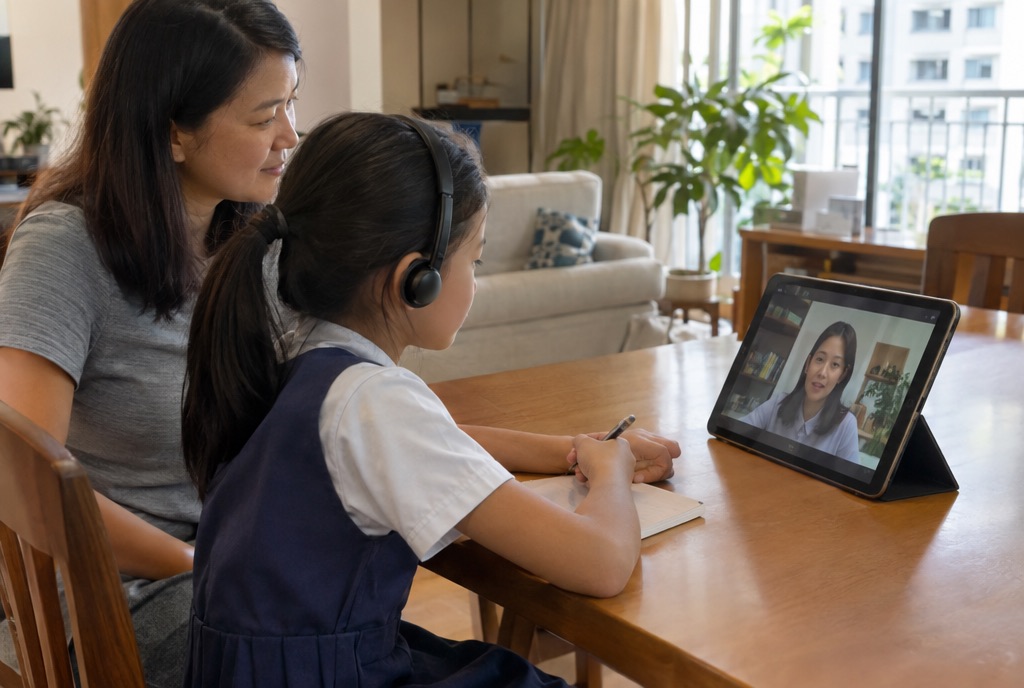
Primary school tuition online usually covers English, Maths, Science and Mother Tongue. PSLE tuition adds timed papers and the AL grade the child is trying to move. One hour is a typical lesson. Two shorter sessions can work better than one long one for Primary 3 and Primary 4.
Secondary, N-Level and O-Level
Secondary tuition follows the student’s stream and subject combination. N-Level and O-Level lessons should use the current syllabus and recent papers, not a generic worksheet pack. Exam years need past-paper timing. Lower secondary more often needs the concept that slipped in class.
Junior college and A-Level
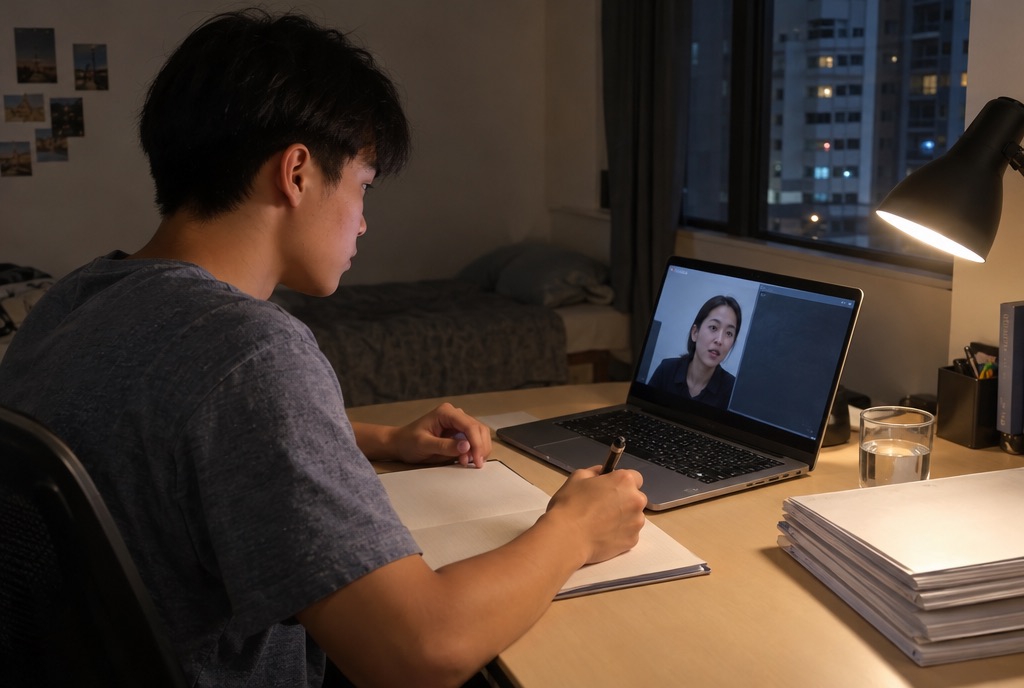
JC tuition and A-Level tuition are a strong fit for online lessons. H2 Maths, Chemistry, Physics, Economics and General Paper are paper-and-explanation subjects. The student is old enough to manage the call, share written working, and redo a question after the lesson.
IB, IGCSE, IP, polytechnic and university
International-school and tertiary students already do a large share of work online. IB, IGCSE, IP, polytechnic and university requests should name the syllabus, the paper, and whether the help is for class tests or a final exam. Hourly bands for IB and IGCSE are set out in the 2026 IB, IGCSE and A-Level fee guide.
Subjects taught online
The match is by subject and level together. A primary maths tutor and an H2 Maths tutor are not interchangeable. These are the subject pages families use most often when they want a one-to-one tutor who can also teach on video:
- English and General Paper
- Maths, from primary through H2
- Science, Physics, Chemistry and Biology
- Chinese, including higher Chinese
- Economics and the other humanities papers the student is sitting
Free practice material for school exams sits on the test-paper page. A tutor can mark that work in the online lesson. The paper alone does not replace the explanation.
Online tuition rates in Singapore, 2026
Use the row for the student’s level and the column for the tutor’s background. Part-time means a university student or someone tutoring alongside another job. Full-time means private tuition is the person’s main work. The school-teacher column is for current or former MOE teachers. A current teacher still has to be allowed to take paid tuition. Online lessons use this same table. Because the tutor saves the trip, the quote often sits toward the bottom of the matching cell.
Top of the part-time band, selected levels
| Level | Part-time tutor | Full-time tutor | Current or former school teacher |
|---|---|---|---|
| Pre-school (Nursery, K1–K2) | $25–35 | $35–45 | $50–60 |
| Lower primary | $25–35 | $40–45 | $55–70 |
| Upper primary | $30–40 | $45–55 | $60–85 |
| Lower secondary | $30–40 | $45–50 | $60–85 |
| Upper secondary | $35–45 | $45–60 | $65–95 |
| Junior college | $50–65 | $70–90 | $100–130 |
| IB Primary Years | $35–45 | $45–55 | — |
| IB Middle Years | $40–55 | $55–80 | — |
| IB Diploma | $55–70 | $70–100 | — |
| IGCSE | $35–55 | $50–90 | — |
| Diploma, polytechnic, university | $60–70 | $80–120 | — |
These ranges are Tutor Circle’s October 2026 reference from past one-to-one assignments. They are not a fixed price list, an official tariff, or a quote. The rate is agreed with the tutor. A dash means that column is not used for that row.
A worked budget, using the table as published: one 1.5-hour upper-primary lesson a week with a part-time tutor at $30–40 an hour is about $180–240 for four lessons. The same arithmetic at junior college, at $50–65 an hour, is about $300–390 for four 1.5-hour lessons. A longer lesson, a full-time tutor, or a school-teacher rate changes the total. The full table, including adult language and test-prep rows, is in the tuition rate guide. A shorter public overview is on the tuition fee page.
How online lessons are conducted
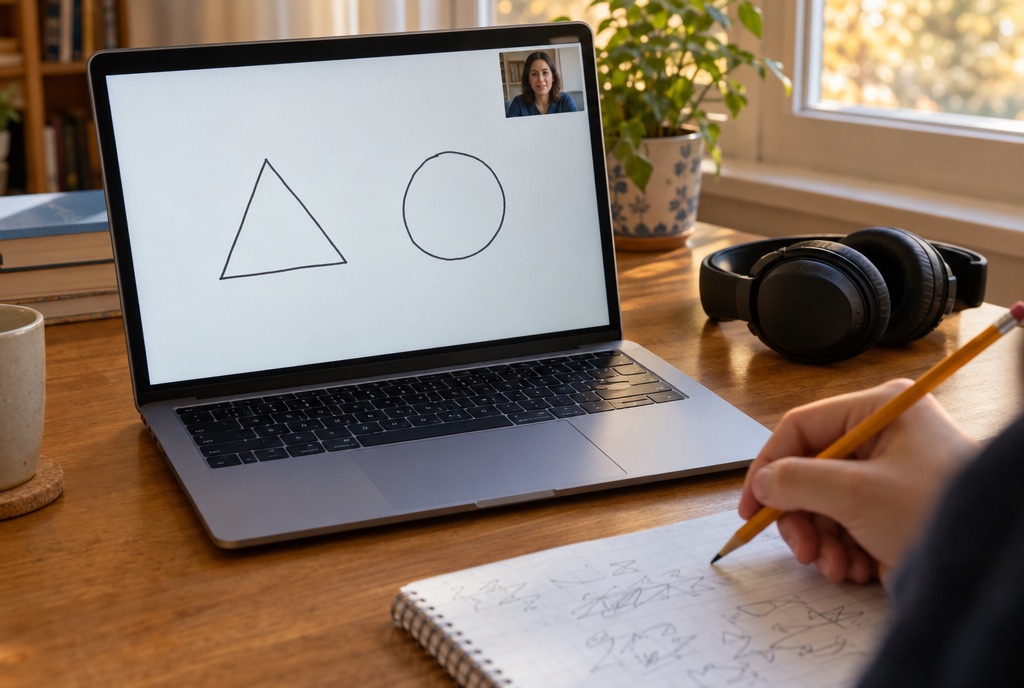
Tutor Circle tutors commonly use Zoom or Google Meet. Microsoft Teams works as well if the student’s school account is already on it. The tool matters less than a stable connection and a shared screen.
- Before the first lesson, agree the link, the time, and who sends the schoolwork.
- The tutor shares a whiteboard or a document. The student writes in a physical notebook and holds the working up to the camera when that is clearer than typing.
- A full hour needs a host plan that covers it. Zoom’s free Basic plan ends a meeting at 40 minutes, including a one-to-one call. [6] On a free personal Google account, a one-to-one Meet call can run up to 24 hours, while a call with three or more people stops at 60 minutes. [7] Agree who is hosting before the first lesson.
- Record only with both sides’ agreement. Keep the file for that student’s revision.
- Move or cancel a lesson at least 24 hours ahead, except for illness or another emergency. After the first lesson, the family and the tutor can arrange that directly.
More than 100,000 tutors have registered with Tutor Circle and submitted academic information for verification. Registration is not the same as a finished check on every profile, and it is not a teaching licence. At the first lesson, parents can ask to see the result slip, degree, or photo identification the profile claims.
What the student needs
- A laptop or tablet. A phone is a weak substitute once the tutor shares a worksheet.
- A webcam and a microphone. Headphones cut out the rest of the flat.
- Home broadband that can hold a video call. If the call freezes, a mobile hotspot is the usual backup.
- The week’s worksheets, a notebook, and the assessment book the school is using.
- For primary students, an adult in the room until the child can join the call and stay with the task.
How to request an online tutor
The request takes a few minutes. Coordinators are available daily from 9am to 8pm.
- Send the level, the subject, the school syllabus if it is IB or IGCSE, the days you can do, and the budget you have in mind. Say that the lesson is online.
- Use the request form, or WhatsApp +65 9628 4702. Email info@tutorcircle.sg if you would rather write.
- Read the profiles that come back, usually within 24 hours. Ask for another name if the rate, the timings, or the experience do not fit.
- Confirm one tutor, test the video link before the first lesson, and pay the tutor for lessons that take place.
Online tuition from any neighbourhood in Singapore
The student joins from home, so the tutor does not need to live nearby. A family in Tampines can work with a tutor who usually teaches in Bukit Timah. That is the practical answer to “online tuition near me”: the lesson happens at the student’s address, and the tutor’s address only matters if someone has to travel.
If you would rather the tutor came to the flat, start from the home-tuition page for that area. These are the neighbourhoods parents ask about most often:
Questions parents ask
How much does online tuition cost in Singapore?
Tutor Circle’s October 2026 reference uses the same one-to-one bands as home tuition. A part-time tutor is typically $25–35 an hour for lower primary, $30–40 for upper primary, $35–45 for upper secondary, and $50–65 for junior college. Full-time tutors and current or former school teachers sit higher. Online lessons often land in the lower half of the same band because the tutor does not travel. These figures are a guide from past assignments, not a fixed price.
Is online tuition effective?
One-to-one online tutoring can raise results. In an Italian middle-school trial, three hours a week of individual online maths tutoring raised maths scores by 0.23 standard deviations in 2020 and 0.20 in 2022. Group tutoring in the same study had smaller effects. That programme used volunteer university students and is not a Singapore PSLE or O-Level trial. The useful lesson for a Singapore family is that a scheduled one-to-one lesson, with a tutor who knows the syllabus, is the part that matters.
What does my child need for an online lesson?
A laptop or tablet, a webcam, a microphone, and a stable home broadband connection. Headphones help in a noisy flat. A quiet spot and a notebook still matter: the tutor can share a screen, and the student still writes working by hand. For the first few primary lessons, a parent nearby can help with login and can see whether the child is following.
Which levels and subjects can be taught online?
Tutor Circle matches online tutors from pre-school through primary, secondary, junior college, IB, IGCSE, polytechnic and university. Common subjects include English, Maths, Science, Chinese, Physics, Chemistry, Biology, General Paper and Economics. A chemistry or biology practical is harder to reproduce on a screen, so families often keep those skills for school lab sessions and use the online lesson for concepts, calculations and exam papers.
Do parents pay Tutor Circle an agency fee?
No. Parents pay the tutor for lessons conducted. Tutor Circle’s matching service does not add a parent agency fee on top of the tutor’s rate. Confirm the hourly rate, lesson length and payment arrangement with the tutor before the first lesson.
Can an online lesson be recorded?
Only if the tutor and the family both agree. Zoom’s desktop app can save a local recording. Google Meet recording depends on the host’s account. A recording is useful for revision. It is also the student’s and the tutor’s lesson, so it should not be shared onward.
Is online tuition suitable for primary school children?
Many primary students manage a 60-minute online lesson when the task is concrete and an adult is nearby at the start. Younger children lose focus sooner than secondary students. A shorter lesson, a parent in the room for the first sessions, and a tutor who has taught that primary level are the practical checks. If the child cannot stay with a screen, a tutor who comes to the home is the better arrangement.
How do I request an online tutor?
Submit a request at tutorcircle.sg/application/1 or WhatsApp +65 9628 4702 (daily, 9am–8pm). State the level, subject, preferred days, and that the lesson should be online. Tutor Circle usually sends profiles within 24 hours. You confirm a tutor, agree the rate, and hold the first lesson on Zoom or Google Meet.
What if the tutor is not a good fit?
Tell Tutor Circle and ask for another recommendation. There is no lock-in that forces you to keep a tutor who is not working. Pay for lessons that have already been conducted, and agree any postponed lesson at least a day ahead except in an emergency.
Online tuition or a tutor at home?
Choose online when travel, CCAs or the tutor’s location make a home visit hard, and the student can work on a screen. Choose a home visit when the child is very young, needs someone in the room to keep the lesson moving, or the work is hands-on. The hourly bands are the same reference either way. The difference is travel, supervision and how the student concentrates.
Sources
The hourly table is Tutor Circle’s own October 2026 reference. The links below support the research and the syllabus points in this guide. They do not set tutor prices.
- Michela Carlana and Eliana La Ferrara, “Apart but Connected: Online Tutoring, Cognitive Outcomes, and Soft Skills,” NBER Working Paper 32272 (March 2024), later published in the American Economic Review (2025). Individual online maths tutoring of three hours a week raised scores by 0.23 standard deviations in 2020 and 0.20 in 2022 among Italian middle-school students. This is not a Singapore exam study. Accessed 13 October 2026. https://www.nber.org/papers/w32272
- Andre Nickow, Philip Oreopoulos and Vincent Quan, “The Impressive Effects of Tutoring on PreK-12 Learning: A Systematic Review and Meta-Analysis of the Experimental Evidence,” NBER Working Paper 27476 (2020). The review covers tutoring programmes generally. Most of the underlying trials were in person. Accessed 13 October 2026. https://www.nber.org/papers/w27476
- Ministry of Education, Singapore, “Blended Learning to Enhance Schooling Experience and Further Develop Students into Self-Directed Learners,” press release, 29 December 2020. From 2021, secondary schools, junior colleges and Millennia Institute added regular home-based learning days, alongside in-school lessons. Accessed 13 October 2026. https://www.moe.gov.sg/news/press-releases/20201229-blended-learning-to-enhance-schooling-experience-and-further-develop-students-into-self-directed-learners
- Ministry of Education, Singapore, parliamentary reply, “Impact of home-based learning on the holistic development of students,” 2 November 2021. MOE states that home-based learning cannot fully substitute for school, and notes the extra difficulty for younger students. Accessed 13 October 2026. https://www.moe.gov.sg/news/parliamentary-replies/20211102-impact-of-home-based-learning-on-the-holistic-development-of-students
- Singapore Examinations and Assessment Board, “Secondary Education Certificate (SEC).” From 2027, the Singapore-Cambridge GCE N(T), N(A) and O-Level qualifications are combined and renamed the Singapore-Cambridge Secondary Education Certificate. Accessed 13 October 2026. https://www.seab.gov.sg/secondary-education-certificate-sec/
- Zoom, “Understanding time limits for Zoom Meetings,” support article KB0067966. Meetings hosted by a Basic (free) user end after 40 minutes, including one-to-one meetings. A paid licence can run up to 30 hours. Accessed 13 October 2026. https://support.zoom.com/hc/en/article?id=zm_kb&sysparm_article=KB0067966
- Google, “Learn what requirements you need to use Google Meet.” Without a Google Meet subscription, one-to-one meetings on a computer can last up to 24 hours, and meetings with three or more participants up to 60 minutes. Accessed 13 October 2026. https://support.google.com/meet/answer/7317473?hl=en